Real shotsMomentsVersionsHow it worksPromisesVideosArticlesFAQOur apps

The first Roadster needed a rocket to fly. The new one does it on its own.

Oct 16, 2026 Β· 5 min read

The first Tesla Roadster to leave the ground needed the most powerful rocket flying at the time. In 2018, SpaceX strapped Elon Musk's own cherry-red Roadster to a Falcon Heavy and sent it past the orbit of Mars, where it is still circling the Sun. Eight years later, the new Roadster left the ground on its own, using air thrusters built with SpaceX's help. Same name, same spirit, no rocket required.
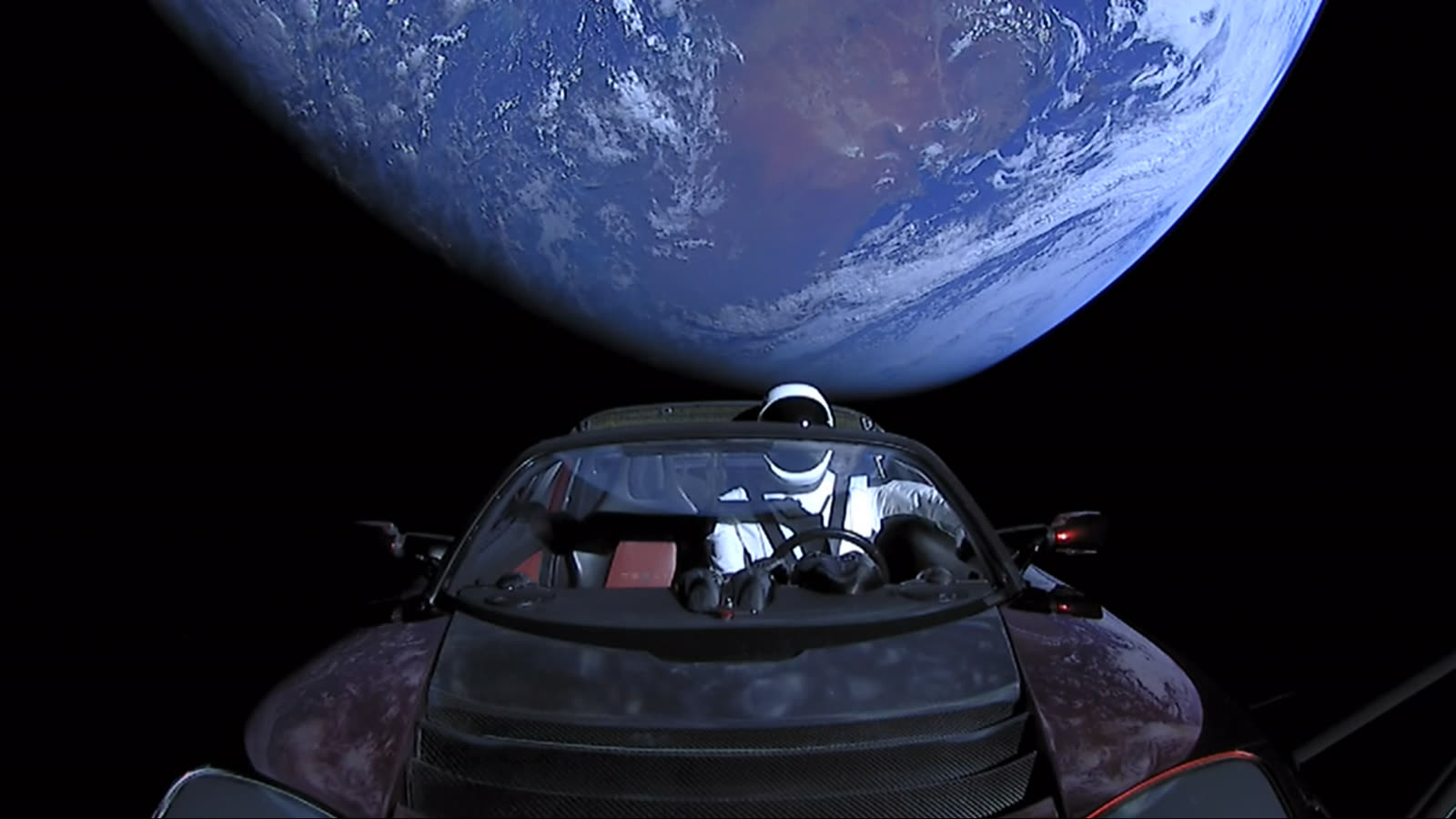
A mannequin in a spacesuit sits in a red Tesla Roadster with Earth filling the sky behind it
Starman at the wheel, Earth behind him, February 2018. Photo: SpaceX, public domain (CC0), via Wikimedia Commons.

2018: the Roadster that rode a rocket

Every new rocket needs something to carry on its first flight. Usually it's a block of concrete or steel. In March 2017, Musk promised the first Falcon Heavy would carry "the silliest thing we can imagine" (Wikipedia).

In December he named it: "Payload will be my midnight cherry Tesla Roadster playing Space Oddity. Destination is Mars orbit. Will be in deep space for a billion years or so if it doesn't blow up on ascent" (Electrek). Plenty of people assumed he was joking. He wasn't.

The car was Musk's own 2010 Roadster, the model Tesla started out with (Wikipedia, Hagerty). On February 6, 2018, at 3:45 pm Eastern, the Falcon Heavy lifted off from Launch Complex 39A at Kennedy Space Center, the same pad Apollo 11 left from (Wikipedia). About eight minutes later, its two side boosters landed back at Cape Canaveral, side by side (The Planetary Society).
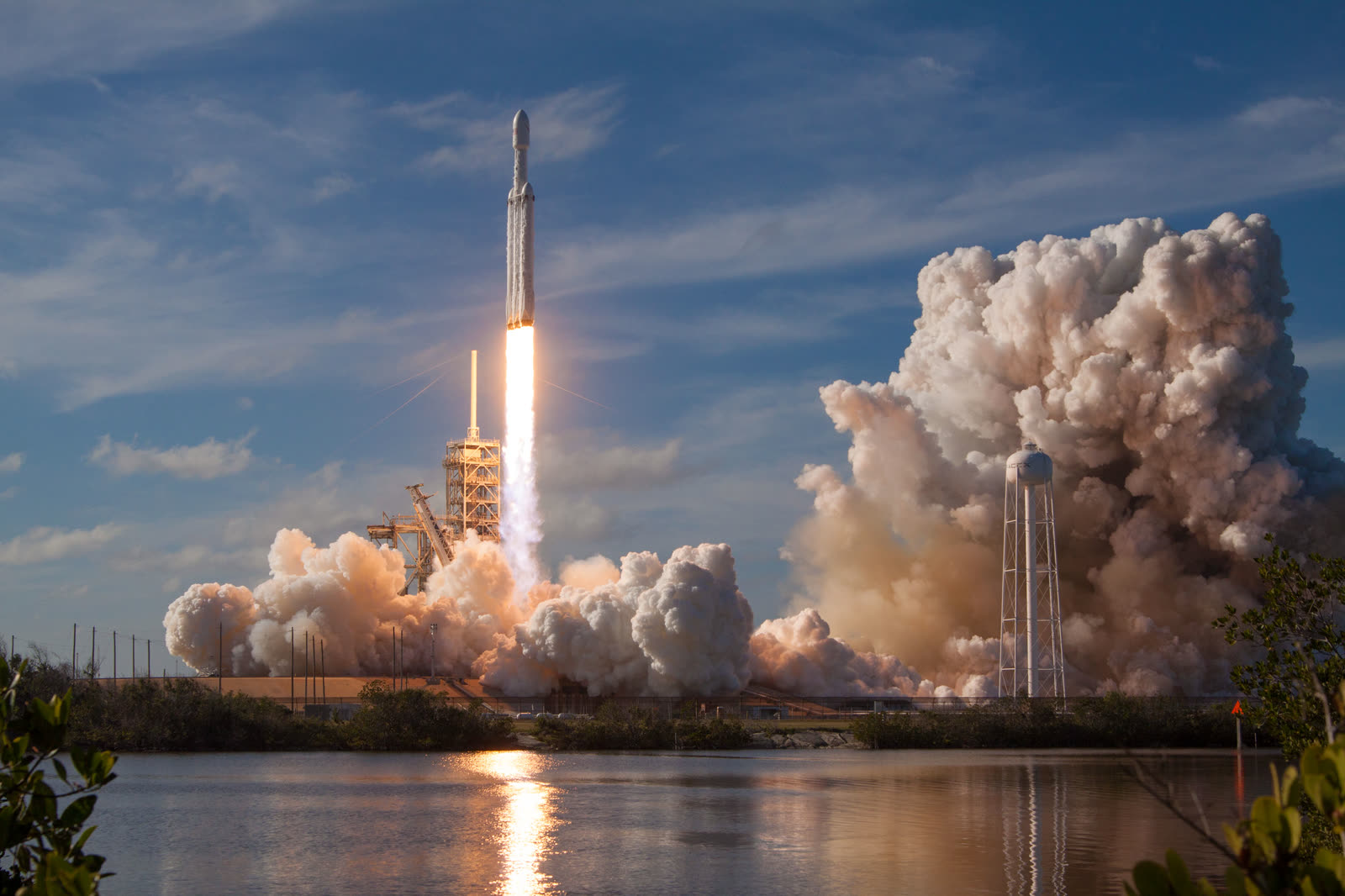
Falcon Heavy rocket lifting off, seen across the water
Falcon Heavy lifts off from Pad 39A with the Roadster inside its nose, February 6, 2018. Photo: SpaceX, public domain (CC0), via Wikimedia Commons.

Musk summed it up after launch: "It is just literally a normal car, in space" (collectSPACE).

What went along for the ride

SpaceX packed the car with jokes and messages (collectSPACE, Wikipedia):

  • Starman, a mannequin in a SpaceX pressure suit, named after the David Bowie song, with one hand on the wheel.
  • "Space Oddity" by David Bowie, playing on a loop.
  • "DON'T PANIC" on the dashboard screen, the famous line from The Hitchhiker's Guide to the Galaxy. A copy of the book and a towel came too.
  • A tiny Hot Wheels Roadster on the dashboard, with a tiny Starman inside.
  • A plaque with the names of more than 6,000 SpaceX employees.
  • "Made on Earth by humans," printed on one of the car's circuit boards.
  • A small quartz disc holding Isaac Asimov's Foundation books, made to last billions of years (SpaceQ).
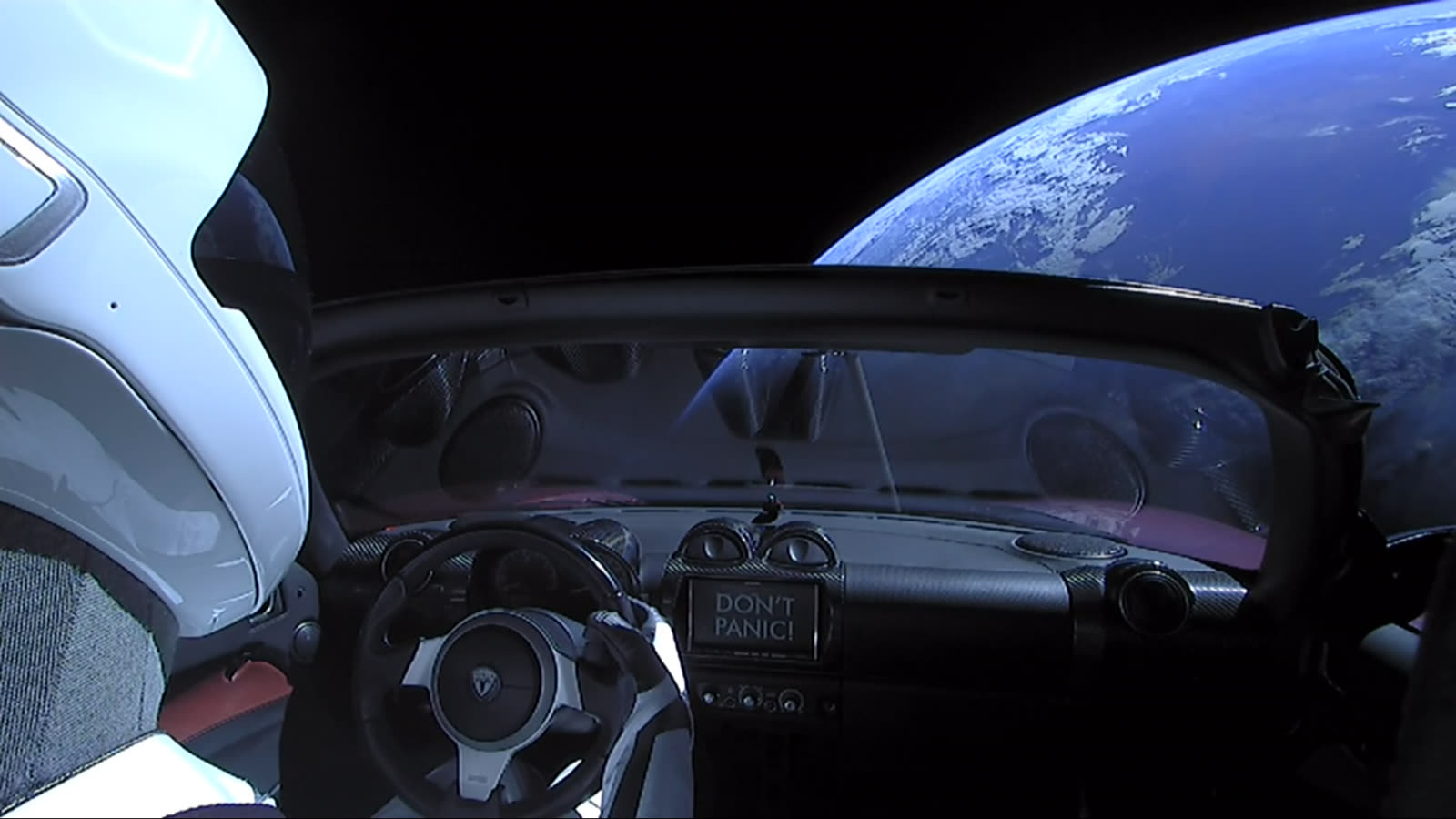
View over Starman's shoulder showing the steering wheel and a DON'T PANIC sign on the dashboard, with Earth beyond
"DON'T PANIC" on the dash, Earth through the windshield. Photo: SpaceX, public domain (CC0), via Wikimedia Commons.

Where it is right now

The car never went into orbit around Mars. It circles the Sun on a stretched loop that reaches just past Mars' orbit and swings back in to about Earth's distance. One lap takes about 557 days (Wikipedia, NASA/JPL). On October 7, 2020, it passed Mars at about 5 million miles (Live Science).

As of October 16, 2026, according to the live tracker at whereisroadster.com, checked against NASA/JPL data:

Distance from Earth about 61.5 million miles, moving away
Distance from the Sun about 139 million miles
Speed around the Sun about 50,700 mph
Laps around the Sun about 5.7
Total distance traveled about 4.31 billion miles
Its 36,000-mile warranty used up about 119,600 times

Its next closest pass to the Sun is around April 2027 (NASA/JPL).

Is it still in one piece?

Probably not looking its best. On launch day, chemist William Carroll told Live Science that radiation would break down the plastics, leather, rubber and paint: "Those organics, in that environment, I wouldn't give them a year" (Live Science). The metal frame should last much longer. Nobody has photographed the car since it left, so nobody knows for sure.

Will it ever come home? Scientists who modeled its path found a small chance it hits Earth or Venus someday, but on a scale of millions of years. Its first close pass by Earth comes in 2091 (Rein et al., 2018).

One more thought. Nobody has checked on Starman since February 2018. Down here, we can do better for the people we love who live alone. That's why we built Support-O: one tap each morning, and if they don't answer, the people they chose get a text.

2026: the Roadster that lifts itself

On October 15, 2026, at SpaceX's test site in McGregor, Texas, the new Roadster drove up a nearly upside-down ramp, dropped off, rolled upright in midair with its thrusters and landed. Then it flipped over a row of five Teslas (TechCrunch).

Tesla's own video of the new Roadster's kickflip. Tap to play on YouTube.

No rocket this time. The new car carries about 250 kg of compressed air in carbon-wrapped tanks, the same kind SpaceX uses, and blasts it out of nozzles to push, lift and roll the car. There's no fuel and no fire (Paultan, CarBuzz). Musk's description: "we borrowed some technology from SpaceX to do the rest" (Drive Tesla). Here's the math on how long the air lasts.

The link between the two cars was there all along. In June 2018, four months after the launch, Musk tweeted that a "SpaceX option package" for the new Roadster would include "~10 small rocket thrusters arranged seamlessly around car" (Fortune). The top version revealed in 2026 has exactly 10 (TechCrunch).

And during the stunts, a "Starman" dummy sat in the driver's seat. Paultan called it "a nod to the original Roadster that SpaceX launched into space in 2018" (Paultan, SlashGear).

Then and now

2018: first Roadster 2026: new Roadster
How it left the ground Rode inside a Falcon Heavy rocket Its own air thrusters
SpaceX's part The rocket The thruster technology
Who was driving Starman Starman (a dummy, for the stunts)
How high it went Past the orbit of Mars About 7 m on the kickflip; the ramp top was about 21 m (Paultan's estimates)
Is it coming back? Not for millions of years Production planned for 2028, Musk says

The first Roadster went farther. The new one doesn't need a ride.

Space photos by SpaceX, released into the public domain. Roadster Flies is an independent fan site, not affiliated with Tesla or SpaceX. Tesla's numbers are Tesla's claims until someone tests them.

Sources:

Roadster Flies is an independent fan site, not affiliated with Tesla. Tesla's numbers are marked as Tesla's claims until someone tests them. Spot a mistake? Tell us.