Real shotsMomentsVersionsHow it worksPromisesVideosArticlesFAQOur apps

Has Elon finally built KITT? Every Knight Rider car vs. the flying Tesla Roadster

Oct 16, 2026 · 8 min read

Almost. The new Tesla Roadster does things no KITT ever did for real: it jumps on air thrusters, flips in midair and drives up a wall nearly upside down. KITT still wins on brains. It talked, drove itself and shrugged off bullets, and the Roadster does none of that yet. Knowing who builds it, we wouldn't bet on "yet" lasting long.
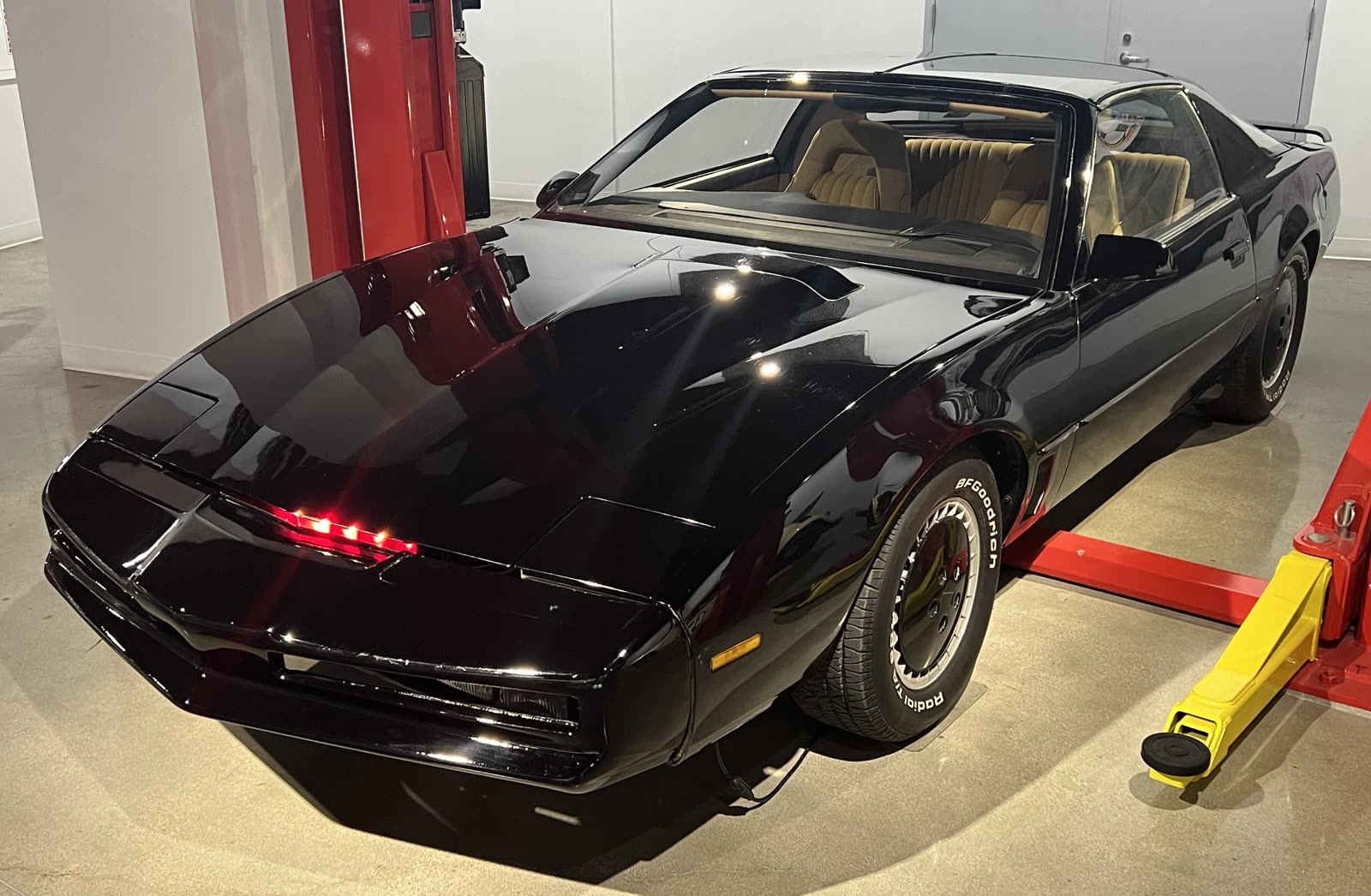
Black 1982 Pontiac Trans Am KITT with its red scanner lit, at the Petersen Automotive Museum
The original: a 1982 Pontiac Trans Am KITT at the Petersen Automotive Museum, Los Angeles. Photo: TaurusEmerald, CC BY-SA 4.0, via Wikimedia Commons.

The car every 80s kid wanted

Knight Rider ran on NBC from September 26, 1982 to April 4, 1986: four seasons and 90 episodes (Wikipedia). Creator Glen A. Larson put it simply: "I wanted to do The Lone Ranger with a car" (Mental Floss). David Hasselhoff played Michael Knight. The real star was his car.

KITT, the Knight Industries Two Thousand, talked back, drove itself and jumped over trouble with the press of a button marked "Turbo Boost." The voice was William Daniels, who asked not to be credited and recorded each episode alone. "I knocked off an episode in about 45 minutes," he said. He didn't meet Hasselhoff until the show's Christmas party (Mental Floss).

There have been three KITTs. Here is each one, then the Roadster.

KITT, 1982: the Trans Am

The first KITT was a black 1982 Pontiac Firebird Trans Am. Michael Scheffe designed its nose and its famous dashboard (Wikipedia). The red light sweeping across the front came from Larson's other show, Battlestar Galactica: he wanted the same scanner the Cylon robots had, and KITT even reused the Cylon sound (Wikipedia).
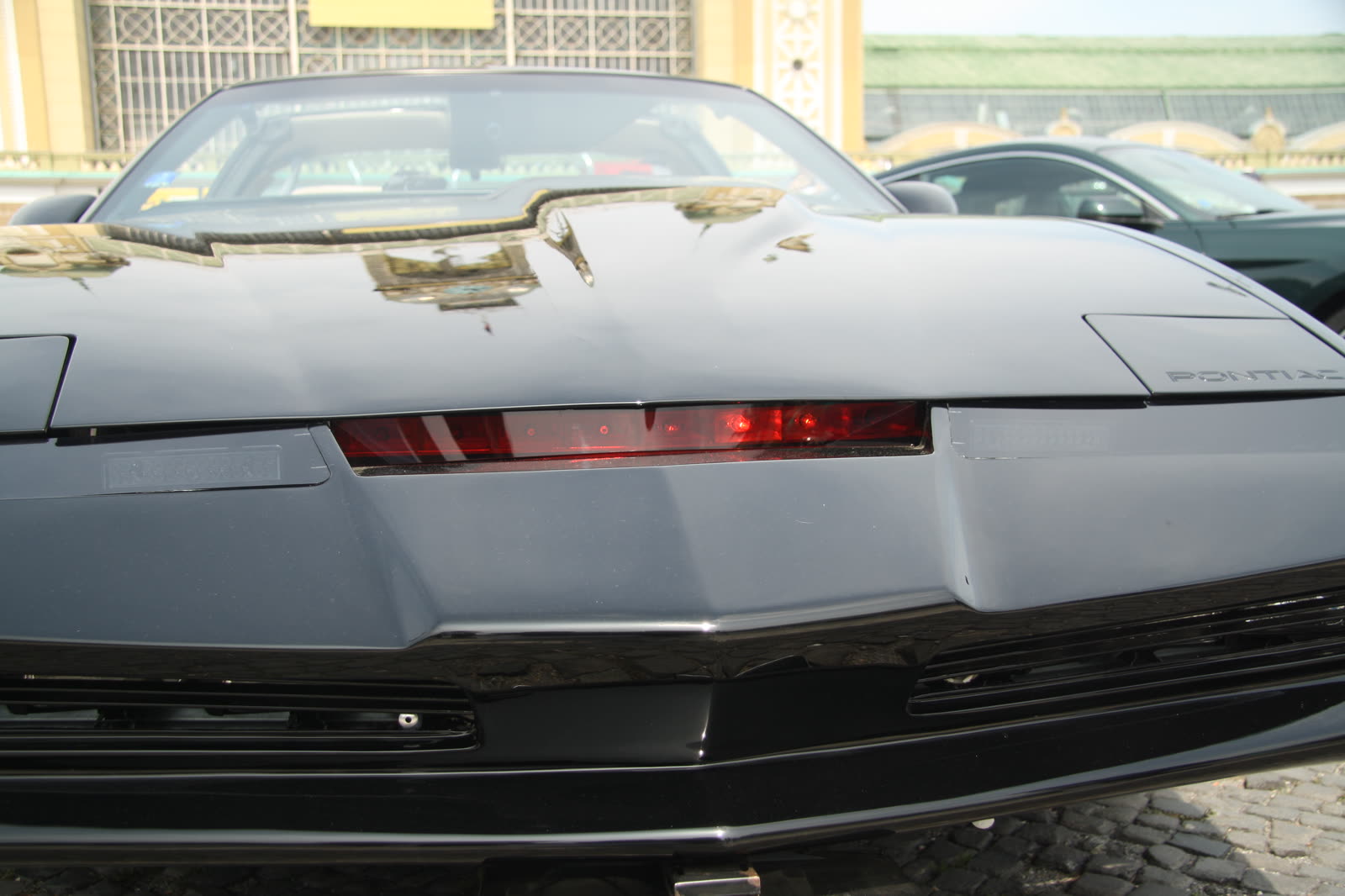
Close-up of KITT's red front scanner light
The scanner Larson borrowed from his Cylons. Photo: Jiří Sedláček, CC BY-SA 4.0, via Wikimedia Commons.

On the show, KITT could:

  • Turbo Boost: fire rocket boosters behind the front wheels and jump over cars, trucks and roadblocks (Wikipedia).
  • Drive itself in "Auto Cruise," and team up with Michael in "Pursuit Mode" (Wikipedia).
  • Shrug off bullets with its "Molecular Bonded Shell" (Wikipedia).
  • Talk to Michael through his wristwatch, a two-way comlink (Wikipedia).
  • Drive on two wheels, spray an oil slick, lay a smoke screen and eject a passenger (Wikipedia).

Fans usually quote KITT at 0–60 in about 2 seconds and around 300 mph. Even Ford's 2007 press release repeated the 300 mph figure (Ford, 2007). None of it was real. GM sold the production some Firebirds for $1 each, including cars from a derailed transporter (Road & Track). Wikipedia lists the real engine as a 5.0-liter V8 with about 145 horsepower (Wikipedia). The "self-driving" scenes hid a stunt driver in a low seat on the passenger side (Mental Floss). Around 20 to 25 cars were built, and five survive (Road & Track).
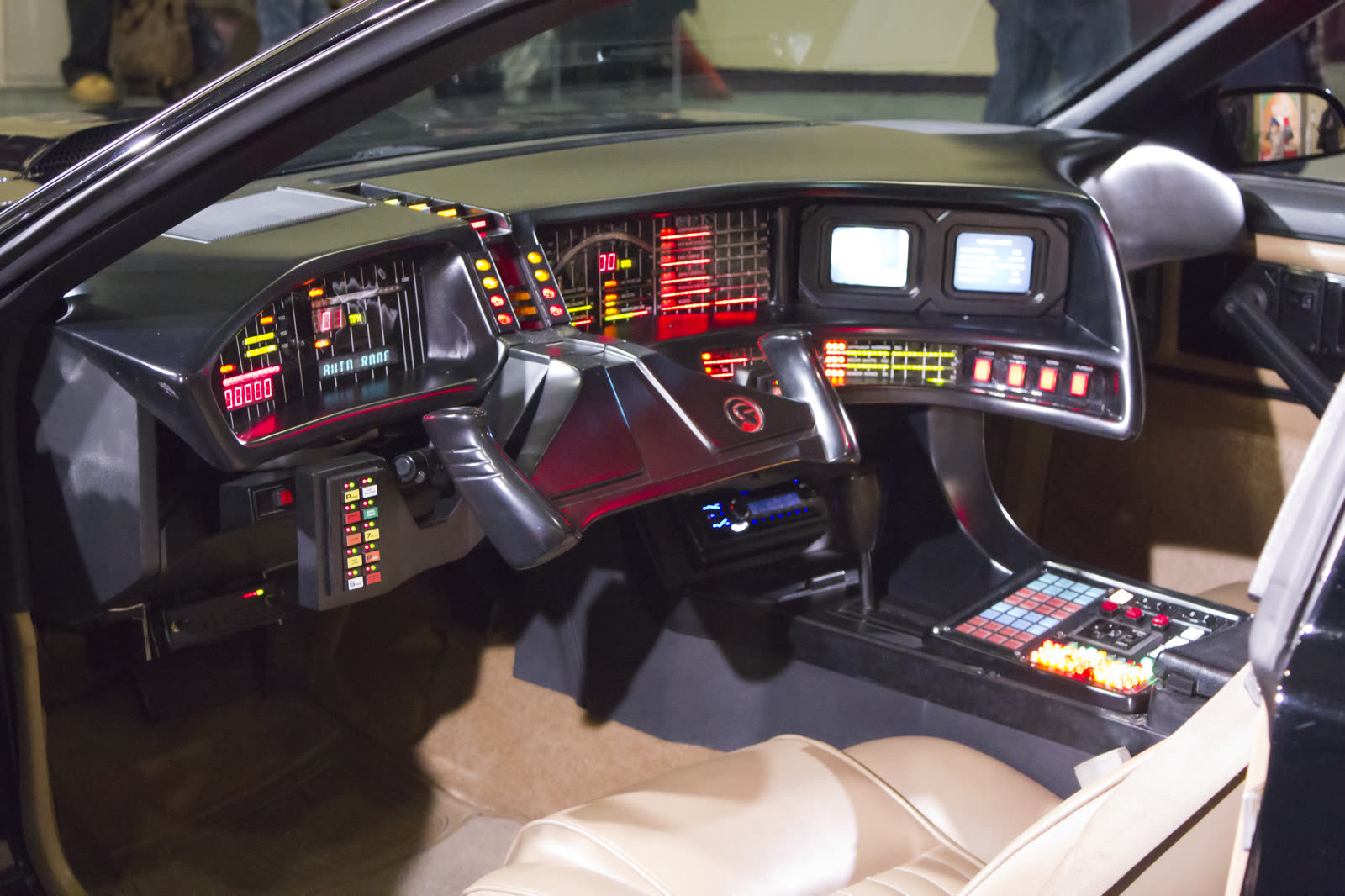
KITT's dashboard with twin screens, a steering yoke and rows of buttons
The dashboard that sold a million toy cars: twin screens, a yoke and buttons everywhere. Photo: Tabercil, CC BY-SA 3.0, via Wikimedia Commons.

Look closely at that dashboard: a steering yoke instead of a round wheel. Forty years later, the new Roadster has one too (Electrek).

Knight 4000, 1991: the one that looked like a 90s Firebird

KITT came back in the TV movie Knight Rider 2000, aired on NBC on May 19, 1991 (Wikipedia). Michael rebuilds KITT's brain and moves it into a new car, the Knight 4000. Underneath, it was a Dodge Stealth, built by Jay Ohrberg's Star Cars and styled after Pontiac's Banshee IV concept car (Wikipedia).

If you remember it as a mid-90s Firebird, you're not far off. The Banshee IV set the look of the fourth-generation Firebird sold from 1993 to 2002 (Wikipedia). The Knight 4000 added a heads-up display, an amphibious mode and a microwave device that could stun a person (Wikipedia). No licensed photo of the car exists that we can show you.

Two 90s shows people often mix up don't count. Knight Rider 2010 (1994) used a Mustang-bodied car with an AI named Hannah (Wikipedia). Team Knight Rider (1997–98) ran a fleet of Fords, and KITT only got a mention (Wikipedia).

KITT, 2008: the shape-shifting Mustang

NBC brought KITT back in 2008 as the Knight Industries Three Thousand: a TV movie in February, then 17 episodes from September 2008 to March 2009 (Wikipedia). The car was a black Ford Shelby GT500KR. Val Kilmer voiced KITT, uncredited. He replaced Will Arnett, who stepped aside because he was the voice of GMC trucks and the show car was a Ford (Wikipedia).
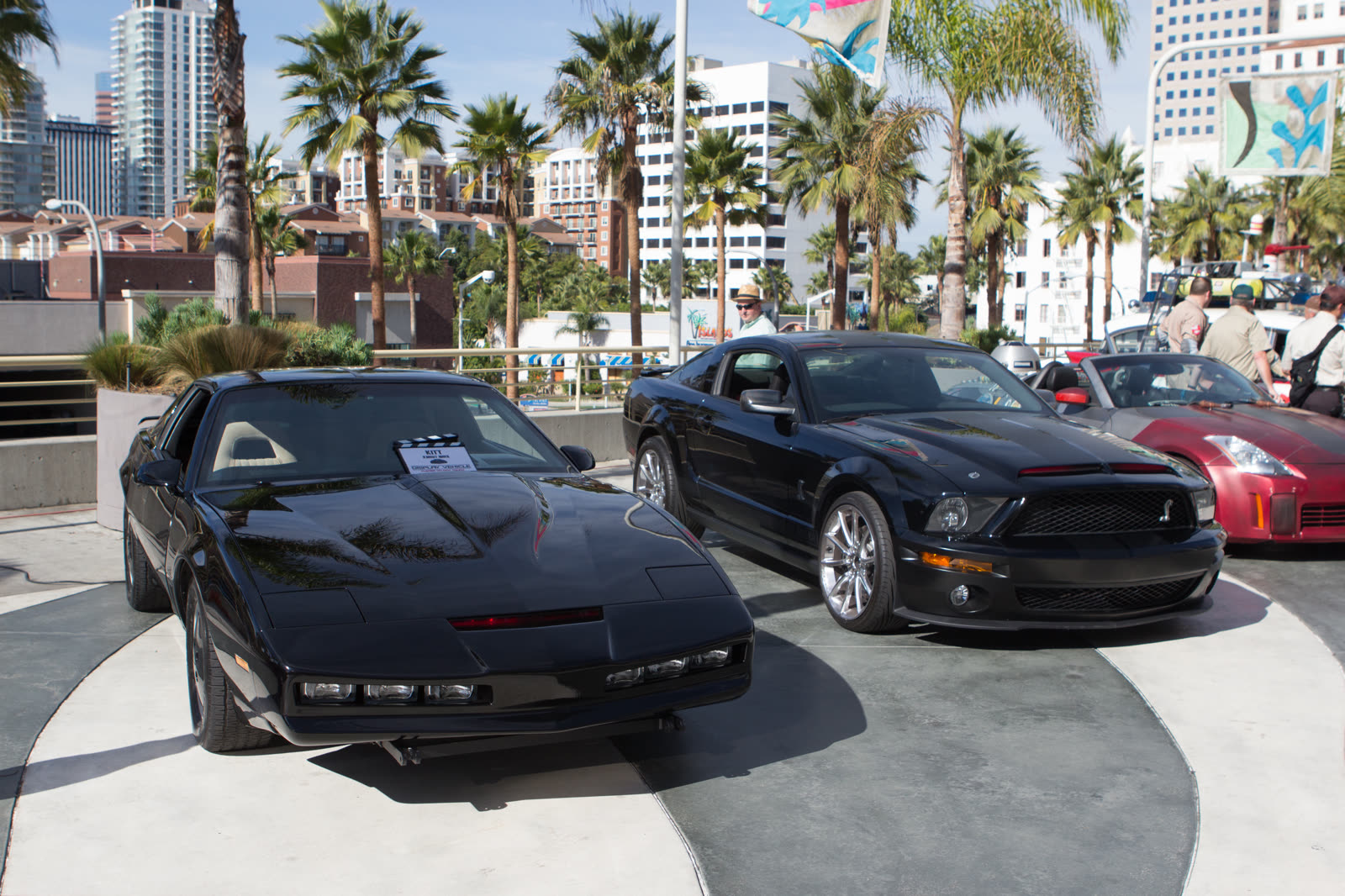
The 1982 Trans Am KITT and the 2008 Shelby GT500KR KITT parked side by side
Two generations of KITT side by side: the 1982 Trans Am and the 2008 Shelby GT500KR. Photo: Pat Loika, CC BY 2.0, via Wikimedia Commons.

Ford's own description: KITT's body "can change shape and color through nanotechnology, and its supercomputer can hack almost any system" (Ford, 2007). It turned into an F-150 pickup, a van and a Ford Flex. Its "Attack Mode" brought back the Turbo Boost, now good for brief flight (Wikipedia). In the story, anyway.

The Roadster, 2026: the one that actually flew

On October 15, 2026, at SpaceX's test site in McGregor, Texas, a Tesla Roadster drove up a curved ramp until it was nearly upside down, held on by fans sucking it to the surface. It dropped off, fired its air thrusters, rolled upright in midair and landed. Then it flipped over a row of five Teslas (TechCrunch). How it works, step by step.

Tesla's own video of the kickflip. Tap to play on YouTube.

Even the press reached for the same comparison. CarBuzz wrote that "there's no denying the car launched itself into the air like a Knight Rider turbo boost" (CarBuzz).

All four, side by side

KITT (1982) Knight 4000 (1991) KITT (2008) Tesla Roadster (2026)
Real car underneath Pontiac Trans Am Dodge Stealth Ford Shelby GT500KR Its own Tesla design
Jump Turbo Boost (TV) KITT's features (TV) Turbo Boost, brief flight (TV) Real: air-thruster jumps and flips
Drives upside down No No No Real: up a near-vertical ramp
0–60 mph About 2 s (fan figure) Not stated Not stated 0.81 s on stage; under 0.59 s claimed
Top speed About 300 mph (fan figure) Not stated Not stated Over 230 mph (Tesla claim)
Talks Yes Yes Yes Not announced
Drives itself Yes (TV) Yes (TV) Yes (TV) No, it's meant to be driven by you
Armor Molecular Bonded Shell Yes (TV) Nanotech shell No
Watch link Comlink wristwatch Not stated Not stated No
Shape-shifting No No F-150, van, Flex (TV) Moving rear wing
Seats 2 2 2 2, or 1 in the Rocket version

Sources: KITT columns from Wikipedia and Ford. Roadster column from Electrek, TechCrunch and SlashGear. The Roadster's numbers are Tesla's own and haven't been tested independently.

What the Roadster does that no KITT ever could

It did it for real. Every KITT stunt was a ramp, a hidden driver or film played fast (Mental Floss). The Roadster flipped live, in front of a crowd.

It drives on the ceiling. Fans under the car pull it to the surface hard enough, Tesla says, to hold it upside down even when parked (Electrek). Not one KITT tried that.

It flips. KITT's Turbo Boost was a straight jump. The Roadster rolled in midair and landed on its wheels.

It's quicker. KITT's fan-quoted 0–60 is about 2 seconds. The Roadster showed 0.81 on stage, timed by Tesla (SlashGear).

What KITT could do, and why we wouldn't bet against Elon

KITT talked. The Roadster hasn't been given a voice. But back in July 2018, a Tesla owner asked Musk if Teslas would get "K.I.T.T. like A.I." He answered with one word: "Yes" (GearBrain). Seven years later, Tesla started putting the Grok AI assistant in its cars (Not a Tesla App). We're just saying.

KITT drove itself. Here the Roadster goes the other way on purpose: Musk says it will be Tesla's one car built for a human to drive (TechCrunch). Then again, nobody was sitting in it for the stunts.

KITT came when Michael called his watch. Today's Teslas can already drive across a parking lot to their owner when called from the phone app (Not a Tesla App). The watch is a detail.

KITT was bulletproof. The Roadster isn't, and Musk says it is "not necessarily a safety-optimized car" (TechCrunch). This is the company that wrapped a pickup truck in stainless steel, so we'd call that a choice, not a limit.

KITT had a flamethrower. The Roadster doesn't. Musk's Boring Company did sell 20,000 "Not-a-Flamethrowers" at $500 each in 2018 (Business Insider). Draw your own conclusions.

KITT went underwater. The Knight 4000 had an amphibious mode. The Roadster can't swim. Its designers did name the submarine Lotus from the James Bond film The Spy Who Loved Me as an inspiration, and Musk owns that car (TechCrunch).

KITT drove on two wheels. The Roadster hasn't tried. Elon, if you're reading this: we would watch that livestream too.

The best thing KITT ever did

It wasn't the Turbo Boost. It was that KITT always knew when Michael was in trouble, and always showed up. Every kid watching wanted that: something that keeps an eye on you.

That idea doesn't need a flying car. It's why we built Support-O: one tap each morning, and if someone you love who lives alone doesn't answer, the people they chose get a text.

So, did Elon build KITT?

He built the half that looked impossible in 1982. A car really did jump, flip and drive upside down, with nobody faking it. KITT's other half, the voice and the brain, is the half Tesla already works on every day. If the two ever meet in one car, Michael Knight would want the keys.

Knight Rider and KITT belong to their owners. Universal Television co-produced the series, and it is now part of NBCUniversal (Wikipedia). Roadster Flies isn't affiliated with or endorsed by NBCUniversal or Tesla. All KITT photos are of real show cars and replicas, credited to their photographers.

Sources:

Roadster Flies is an independent fan site, not affiliated with Tesla. Tesla's numbers are marked as Tesla's claims until someone tests them. Spot a mistake? Tell us.